Paryushan and Poshan Potli: A Journey from Self-Purification to Self-Nourishment

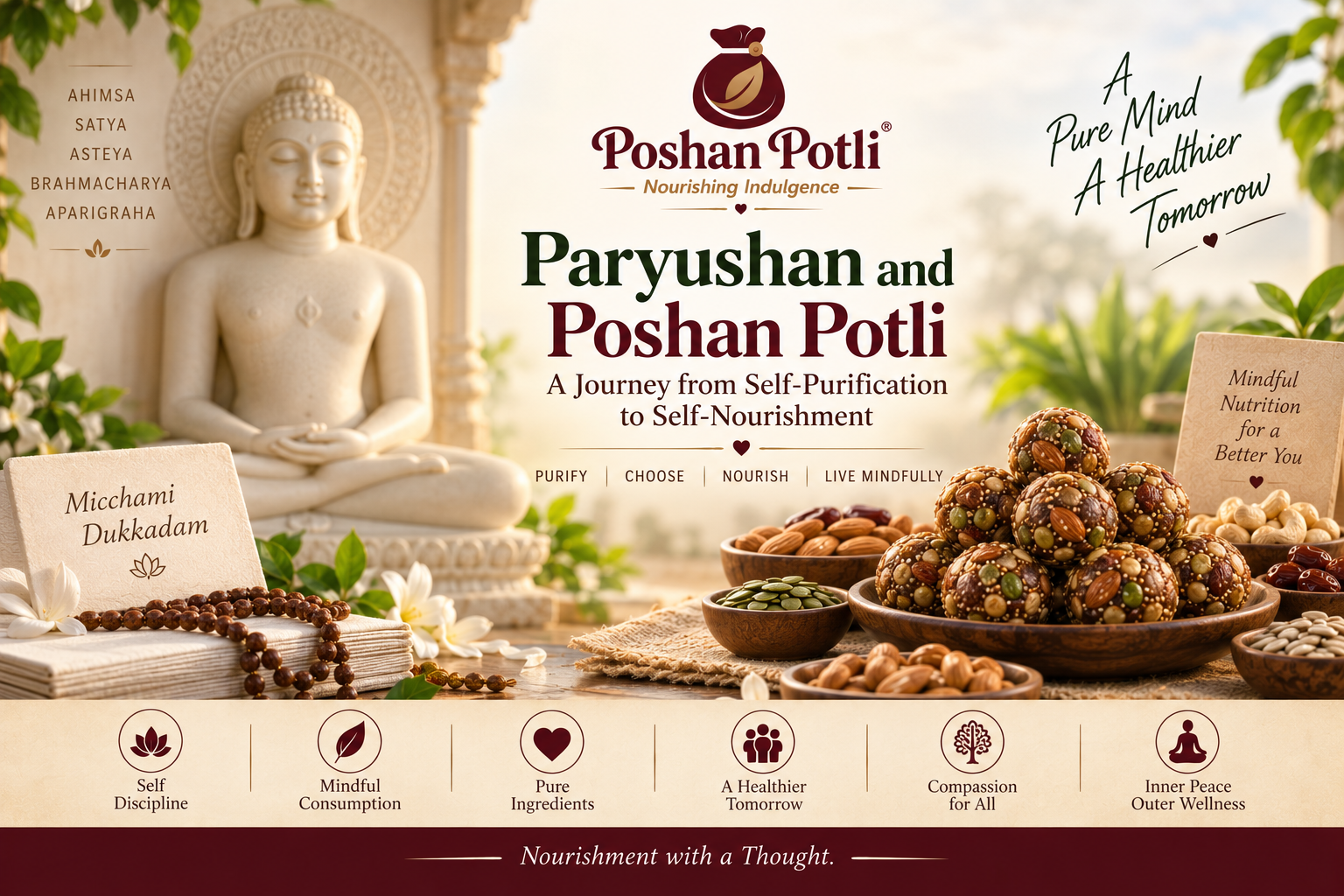
Paryushan is not merely a festival. It is a pause.
A pause from the noise of everyday life.
A pause from excess.
A pause to look within, correct ourselves, seek forgiveness and reconnect with what truly matters.
For the Jain community, Paryushan is a sacred period of self-discipline, introspection, fasting, simplicity and spiritual purification. The observance encourages individuals to examine their actions, control desires, practise restraint and ultimately move towards a purer way of living.
And perhaps there is a beautiful lesson here for our everyday lives:
Just as we need to purify the mind and soul, we also need to consciously nourish the body.
This is where the philosophy behind Poshan Potli finds a meaningful resemblance.
Paryushan teaches restraint. Poshan Potli represents mindful nourishment.
Paryushan reminds us that eating is not merely about satisfying hunger. It is about understanding our relationship with food, desire and self-control.
Fasting during Paryushan represents discipline and restraint. It teaches us that we do not always have to give in to every desire.
Poshan Potli approaches food from the other side of the same philosophy:
When we eat, let us eat consciously.
Instead of unnecessary indulgence, choose nourishment.
Instead of excessive refined sweetness, choose naturally sweetened options.
Instead of eating merely to satisfy the tongue, choose food that provides meaningful nourishment to the body.
Purity is the common thread
One of the central ideas of Paryushan is self-purification—looking within and attempting to remove anger, ego, deceit, greed and other impurities from our conduct.
Poshan Potli’s philosophy similarly begins with an appreciation for simple, recognisable ingredients.
Nuts.
Seeds.
Dry fruits.
Pure ghee.
Natural sweeteners.
The thought is simple:
If we care about what goes into our minds, shouldn’t we also care about what goes into our bodies?
From Aparigraha to conscious consumption
Jain philosophy places great emphasis on aparigraha — non-possessiveness and limiting unnecessary wants.
Modern life often encourages the opposite.
More food.
More sugar.
More consumption.
More indulgence.
Paryushan gives us an opportunity to step back and ask:
“Do I really need more, or do I need better?”
That question is remarkably relevant to nutrition too.
Poshan Potli is built around the thought that nourishment does not need to mean excess.
A small, thoughtfully prepared portion can provide a meaningful combination of nuts, seeds, dry fruits and other nourishing ingredients.
Less excess. More nourishment.
Ahimsa — compassion beyond ourselves
Ahimsa, or non-violence, is one of the foundational principles of Jainism.
During Paryushan, the emphasis on compassion extends towards all living beings. The period encourages people to reflect upon their actions and their impact on others.
This creates another beautiful thought for Poshan Potli:
Food should be approached with gratitude, not greed.
Every ingredient comes from nature. Every meal connects us with farmers, soil, water, plants and countless people involved in bringing food to our table.
Mindful eating therefore becomes more than nutrition.
It becomes gratitude.
Paryushan teaches us to pause. Poshan Potli reminds us to choose.
Perhaps the greatest similarity is the idea of conscious choice.
Paryushan asks:
What should I give up?
Poshan Potli asks:
What should I choose?
One teaches restraint.
The other represents mindful nourishment.
One turns our attention inward towards the soul.
The other encourages us to pay attention to the nourishment of the body.
Together, they inspire a simple philosophy:
**Purify what you can.
Control what you consume.
Nourish what you have.
And live with gratitude.**
The true meaning of “Poshan”
The word Poshan itself means nourishment.
But nourishment is not only about calories, protein, fats or carbohydrates.
True nourishment can be physical, mental, emotional and spiritual.
Paryushan reminds us to nourish the soul through reflection and discipline.
Poshan Potli seeks to nourish the body through thoughtfully chosen ingredients.
And perhaps this is the deeper connection:
A healthy life is not created by one great decision. It is created by hundreds of mindful choices.
What we eat is one of them.
What we think is another.
How we speak is another.
How we treat others is another.
How we control our desires is another.
From “Michhami Dukkadam” to mindful living
The culmination of Paryushan is associated with forgiveness and the practice of Michhami Dukkadam—seeking forgiveness for harm caused knowingly or unknowingly.
It is a powerful reminder that every year we should pause, reflect and improve.
Perhaps we can extend that reflection to our health as well.
Have I taken my body for granted?
Have I fed it merely for taste?
Have I ignored what it truly needs?
Can I make better choices from today?
Because saying Michhami Dukkadam is not merely about looking back.
It is also about making a better beginning.
Paryushan and Poshan Potli — two forms of nourishment
Paryushan nourishes the soul through restraint.
Poshan Potli seeks to nourish the body through mindful food choices.
Paryushan reminds us that more is not always better.
Poshan Potli celebrates the idea that simple can be nourishing.
Paryushan encourages us to control our desires.
Poshan Potli encourages us to make conscious choices when we do eat.
And both ultimately point towards one beautiful idea:
«True well-being begins when we stop living on impulse and start living with awareness.»
This Paryushan, let us not only ask forgiveness from others.
Let us also make peace with ourselves.
Let us respect our body.
Let us respect food.
Let us respect nature.
Let us practise restraint.
And when it is time to eat, let us choose nourishment over indulgence.
Paryushan teaches us to purify.
Poshan Potli reminds us to nourish.
Together, they tell us to live mindfully.
Micchami Dukkadam.
Poshan Potli — Nourishment with a thought.
